


Comparative Table: Meta-Intuition vs Meta-Discernment
This comparative table between meta-intuition and meta-discernment highlights their specificities and complementarity—two analysis abilities mobilized in developing intuitive metacognition (IMC).
| Faculty | Meta-Intuition | Meta-Discernment |
| Definition | Higher and immediate understanding, without conscious reasoning | Higher and reflective judgment, ability to distinguish clearly |
| Process | Spontaneous, often unconscious | Deliberate, involving analysis and reflection |
| Example | Sensing a person is reliable and kind without reason | Assessing if the person is truly reliable and kind by analyzing facts |
| Risks | Can lead to misjudgments | Takes time, may be influenced by biases |
| Usage Context | Quick decisions, creative insights, expanding cognitions | Complex decisions, validating intuitions and meta-intuitions |
By confronting instinctive, unconscious intuitions with conscious, rational, and scientific discernment, intuitive metacognition IMC ultimately provides a more rational and balanced tool for perception, knowledge acquisition, and analysis than simply relying on raw intuitions.Unlike raw intuition, meta-intuition is made conscious and filtered through logic and rationality.
Intuitive Metacognition: A Method for Learning Knowledge and Situational AnalysisIntuitive metacognition is a learning and situational analysis method developed by INTUITIO. It integrates 5 main phases to fully produce its effects.Each of these 5 main phases mobilizes specific perception and analysis abilities.
Mind Map: INTUITIVE METACOGNICTION IMC – Control Your Learning Journey
0. Have a supportive environment.
1. Know yourself. Your abilities, your limits.
2. Know the strategy for intuitive perception and analysis.
3. Plan your learning.
4. Self-control and regulation.
5. Evaluate. Debrief and adjust.
6. Know when it’s learned.
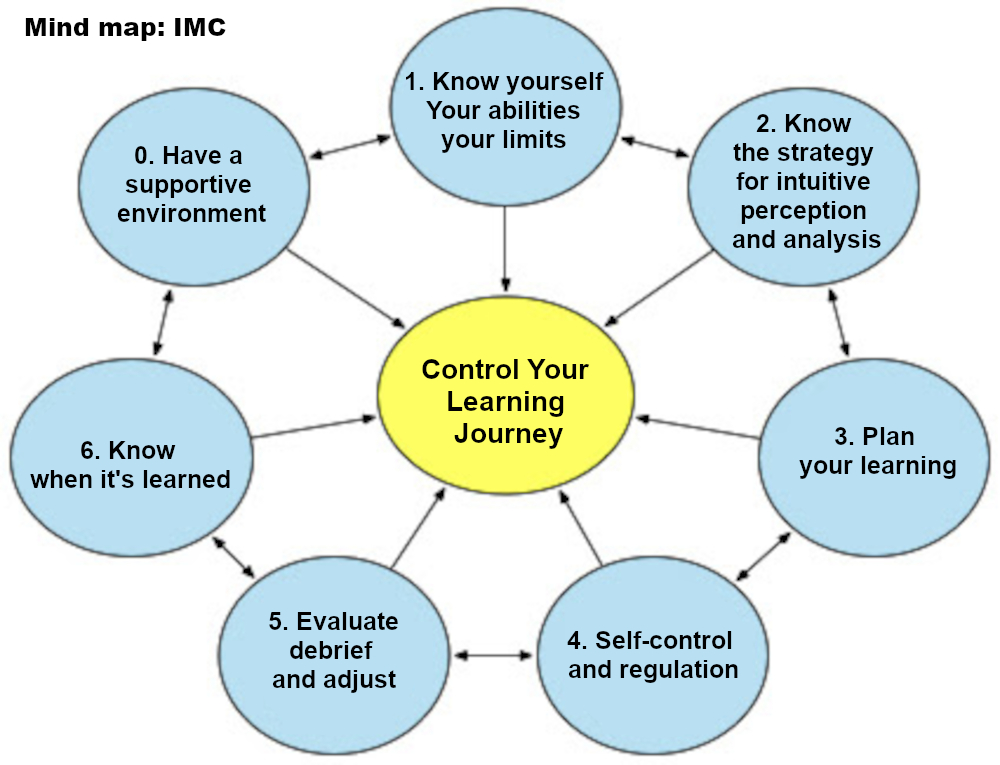
Overall Schema of Intuitive Metacognition
PHASE 1: Know Yourself. Your Abilities, Your Limits.
1. Observe your thoughts and motivations:
Get in the habit of noting thoughts or reactions in key situations (e.g., reflection journal, smartphone).
Example: “What drives me to seek Truth? Why do I need to know more?”
2. Identify your cognitive strengths and weaknesses: Strengths: Are you good at logical problem-solving or understanding others’ emotions? Do you have broad general knowledge? Can you question yourself?
Weaknesses: Do you jump to conclusions or ignore details? Are you often mentally tired?
3. Recognize your biases:
For example, confirmation bias favors info matching your beliefs and can skew judgment. Note when you seek to “be right” instead of understanding.
4. Analyze your emotions:
Emotions influence thinking. If anxious, you might overestimate risks. Learn to spot these (e.g., “Am I over-dramatizing due to stress?”).
5. Analyze how your mind processes information:
Understanding your mind helps distinguish reliable intuition from emotional bias.
Example: If you intuitively feel a solution is right, metacognition asks: “Is this based on past experience, coincidence, wishful thinking, or something new?”
6.Gradually correct shortcomings and biases in your intuitive metacognition work—without undermining strengths or self-confidence. This requires introspection, clarity, and humility.
PHASE 2: Know the Strategy for Intuitive Perception and Analysis.
How to use intuition to approach a conflict or solve a problem:
1. Adopt a proactive, positive approach:
Always act forward to build the best strategy constructively.
2. Combine inner listening and rational analysis:
Intuition is a powerful perception/resolution tool but must be pure, then rationally confronted and validated.
3. Calm yourself to refocus on the issue:
Take a moment to breathe deeply, meditate, and pray to reduce mental noise. A calm, relaxed mind lets intuition speak clearly.
→ If intuition is weak, use INTUITIO exercises to improve.
4. Question your feelings:
Pay attention to physical sensations, inner images, spontaneous emotions (e.g., tension, unease, serenity, inner light). These signal what’s right or problematic. Journal them.
5. Ask a clear question:
Formulate the issue mentally or aloud (e.g., “What’s the best way to resolve this conflict?”). Let your mind answer without forcing.
6. Observe first impressions:
Spontaneous ideas/images are often intuition. Note them automatically in notebook or phone without immediate judgment.
7. Trust but verify:
Cross-check intuitions with facts or objective views when possible.
E.g., if info feels off, explore reasons to confirm/disprove.
8. Experiment in small steps:
Test intuition and adapt your cognitive program with simple actions. Don’t constantly overhaul—start from a solid base and refine.
9. Step back:
If intuition unclear, let the question “rest” (e.g., sleep on it—night brings counsel). The unconscious often clarifies in the background.
Intuition is like a muscle: it strengthens with practice and trust. But it must be illuminated and checked by logic to avoid errors/biases.
10. Feel and question your intuition:
Meta-intuition helps validate/discard first/second intuitions.
E.g., if elements in your metacognition work fit harmoniously and make sense, your intuition is likely right.
PHASE 3: Plan Your Learning.
1. Identify and understand metacognitive planning stakes, recalling the overall cognitive/intuitive schema.
→ INTUITIO and accessible online/book resources can help.
2. Clarify and prepare your mind.
Meditation, prayer, or activities like Qi Gong/Tai Chi help.
3. Define your learning/analysis goal precisely.
Journal it. Use cognitive schemas/mind maps to refine.
4. Plan and organize your approach before tasks.
This sets precise goals, chooses resources (time, docs, emotional load), boosting efficiency/relevance.
E.g.: “Is there cross-verified info online?”
“Can AI help?”
“Do I need advice?”
5. Anticipate obstacles blocking your goal.
Ask: “What biases/emotions might hinder?” (e.g., fear of judgment, procrastination).
6. Use awareness of your thought processes to organize actions strategically/efficiently.
Reflect on how you think, anticipate, adjust planning. Mindfulness meditation helps.
7. Analyze task and goals, anticipate resources (time, docs, emotional load).
Use adapted tools:
. Mind mapping: Draw schema with goal center, steps around; note obstacles/intuitions.
. Intuitive metacognitive journal: Before/after plan execution, write what/why you plan. Later visualize what worked, intuitions, thinking.
8. Practice pauses to observe intuitions/thoughts during planning—for mental clarity.
→ Set alerts: Identify “red flags” (physical tension, negative loops, mental/emotional fatigue) to pause/regulate immediately.
PHASE 4: Self-Control and Regulation.
1. During tasks, regulation monitors progress, adjusts methods, self-corrects.
Improves time management, focus, active learning, precise targeting.
2. Stay “aware”:
Attentive to real-time thoughts/feelings; adapt actions to align with intentions/goal.
3. Practice self-control:
Observe thoughts, emotions, actions during task/situation.
E.g., “I’m lost here—I need to deepen new concepts.”
4. Through regulation, actively adjust thoughts, emotions, behaviors for better results.
E.g., “I’ll breathe deeply and calmly rephrase instead of stubborn thinking.”
5. Respect initial goal:
Master thoughts/emotions to avoid impulsive reactions; refocus on starting objectives—unless reevaluation needed.
6. Integrate intuition:
It acts as alert. If unease during progress, ask: “What does this feeling say?”
“Situation-linked or past experience?”
“Sensitive point?”
7. Use metacognitive questions:
“What am I thinking/feeling?”
“Based on facts or assumptions?”
“Aligned with goal (e.g., resolve life-poisoning issue)?”
“What can I do differently for efficiency?”
“Is intuition consistent with observable facts?”
8. Adjust thoughts/behaviors (regulation):
Pause. If strong emotion/counterproductive thought, breathe/reframe.
E.g.: “I’m off-topic—refocus.”
“Is my unconscious playing tricks?”
9. Redirect thinking positively/proactively:
Replace impulsive/subconscious thought with clear/constructive one.
E.g.: Instead of “this sucks,” think “need coherent idea” or “off-topic—back to previous.”
10. External feedback:
Ask trusted person to observe key decisions for unseen deficient patterns.
PHASE 5: Evaluate. Debrief and Adjust Intuitive Metacognition.
1. After tasks, evaluation analyzes results, what worked/didn’t, possible improvements.
This experience feedback refines strategies, consolidates future learning schema.
2. Debrief, reflect, journal what happened.
E.g.: “Did I manage learning plan? Meet goals?”
3. Identify lessons:
Note successes (e.g., “Pause kept me calm”) and improvements (e.g., “Stopped too soon,” “didn’t follow intuitions enough”).
4. Adjust for future:
Use observations to refine strategies.
E.g.: “Next time, check assumptions before investigating.”
5. Validate progress:
Metacognition, meta-reasoning, meta-perception, meta-intuition—if plan worked and goal met, these strengthen automatically.
7. Mastering intuitive metacognition lets you develop self-coaching program to solve personal/professional issues, access harmonious life/well-being.
8. Mastery also develops analytical/intuitive powers to better understand your world globally.
This avoids traps, protects from manipulation—you and loved ones.
With mastery, fight equally against powerful/malicious manipulators.
Build bridges between the 5 main phases; switch as needed until mastering the intuitive metacognitive process.