

Here is the wheel of life:
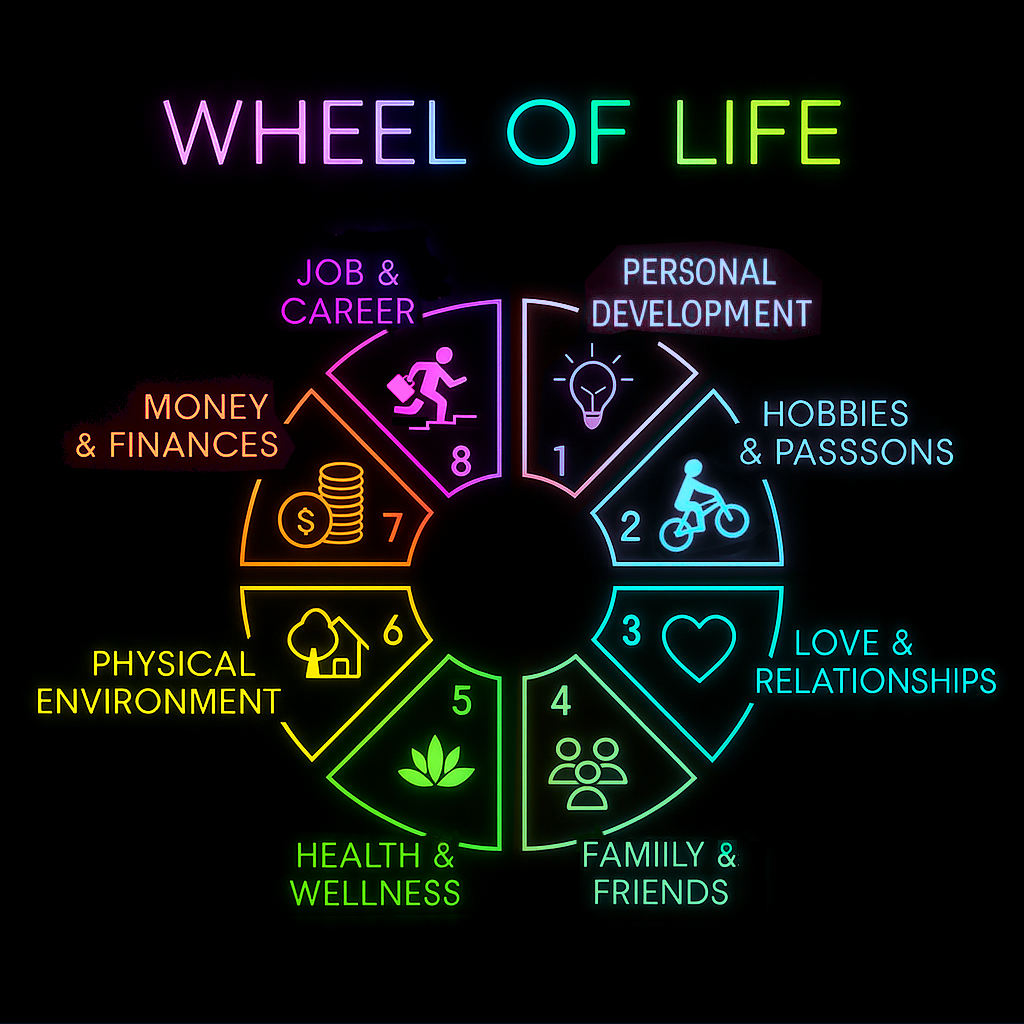
1. Personal Development
The first quadrant is around personal growth (learning or spirituality). It’s up to you what you define as personal growth. Are you looking for spirituality in your life? Or do you like learning? Do you like to read? Do you like to learn a few things all the time? Or are you happy with that quadrant?
2. Hobby & passion
The second quadrant is around fun, leisure, and recreation. Do you make time to have fun in your life? Do you want to make more time for fun? Do you want to find out what leisure activities you would enjoy the most? What’s stopping you from having fun?
3. Love relation
The third life quadrant is your partner or your significant other. Do you have a partner or not? Do you want a partner or don’t you? How is your relationship with your current partner? Can’t it be improved? Do you spend enough time together? Are you driving each other crazy? There can be a whole lot of coaching to do in this area.
4. Family & Friends
The fourth quadrant is around friends and family. Do you have enough friends? Are they positive friends, or are they pulling you down? Do you have your family to help and support you, or are you supporting them? Do you need help with parenting your children or with a difficult family or friendship relationship?
5. Health & Wellness
The next slice is health and wellness. And this can be more than just being healthy and having a life balance. You can look at weight loss coaching, fitness coaching, and nutrition. Are you healthy enough? Or do you need help in that area?
6. Your Physical Environment
The sixth one is your physical environment. Usually, that’s your home environment or your work environment. Rate how satisfied you are with that environment. Do you need to improve anything in that home or work environment?
Say, for example: Someone who scores low on the physical environment slice of their life might want coaching on de-cluttering their life, or they might want to look at what it is in that environment that is not satisfactory, do they, or can they move houses, move countries, improve their environment by personalising it or tidying it up …?
7. Finance and Money
The seventh quadrant is finances and money. Do you have enough money now? Do you need more? Are you planning on retiring? Are you downsizing? Is money causing stress in your life? How can you manage money better? What does money represent for you, and how much money do you actually need to do the things you want?. Can you work out a way to achieve your goals with less money or differently? Finances and money are a whole area in your life around money that you may or may not need help with.
8. Job & Career
The last slice is your career. Are you satisfied with your current job? Do you want to work more, work less, or work differently? Is your job fulfilling? And often, clients do come to coaches specifically seeking help with their career.
This Wheel of Life will help you become aware of the interactions between the different areas that commonly make up life in our contemporary society. This will help you understand the concrete causes of your problem and the actions you need to take to fix it.
How to use this tool ?
1. What does your intuition suggest ?
Previously, you had intuitively expressed and written down in your notebook a problem or a goal you want to achieve. That’s the feeling that drove you to start this intuitive coaching, and it’s important to keep that information precisely.
Now, you’ll be able to compare and contrast this intuitive feeling with your rational mind, and the Wheel of Life will help you do that.
2. What does the Wheel of Life suggest?
So, if you think of yourself as the pizza and all of those little quadrants as sections of your life, you need to rate each of those sections on a scale of zero to ten (0 – 10) in terms of how happy you are and how fulfilled you are for each of those quadrants.
So, for example:
Job & career: If you have a great career, you might give yourself a 10.
Money and finances: If you need to save more money or you have some debts on your finances, you might give that a 4.
Love & relationships : If you have no love in your life and no friends, then you might give a 0 here.
And so on…
Once you have rated each of those quadrants, you can visualize them on the wheel, which areas of your life are low and which areas of your life are high, and focus on the low areas of your life first.
You may find that by improving one area, the other area might improve as well.
Hypothesis:
If you don’t have a job, then your financial quadrant might also be low, and your relationship with your spouse might be tense as well, and you may not be seeing friends or doing leisure activities because of a lack of money. So if you focus on getting a job, then a lot of other quadrants might improve at the same time. Conversely, if you love your job, but you work too hard and too much, then your friendship might suffer, your family might suffer, and your health might suffer as well.
So the wheel of life is really about visualising where your life is at and then trying to get a balance in your life by focusing on the main areas of the wheel, which are the lowest.
As a coach, the wheel of life exercise is really good to do on yourself as well, periodically. Just to reset your focus, and for your own self-development, and also to have a look at your own life and how to balance these over a period of time.
3. What does this comparison suggest to you?
After completing the exercise of scoring each area of your life, you now have a broader view of your problem or the goals you want to achieve. It’s possible that your initial intuition—the one that alerted you to this situation—feels a bit confused in your mind regarding the causes and origins of the problem, as well as the ways to resolve it.
This comparison allows you to put your initial intuitive feelings back into proper perspective.
If your intuition turned out to be off regarding this specific rating, it’s worth asking yourself why it led you astray. True, your intuition did partly work — it correctly alerted you that something deeper was wrong — but it didn’t manage to pinpoint the exact source of the problem and instead pointed you toward a different cause.
The opposite can also happen: when you compare your rational rating with your original intuition, the rational analysis may turn out to be wrong too.
Once you’ve worked through these difficulties and are convinced you’ve identified the real initial cause of your request, write it down in your notebook and move on to the next step. At any time, you can come back to the Wheel of Life to check that everything still feels fully aligned with your inner sensations.