

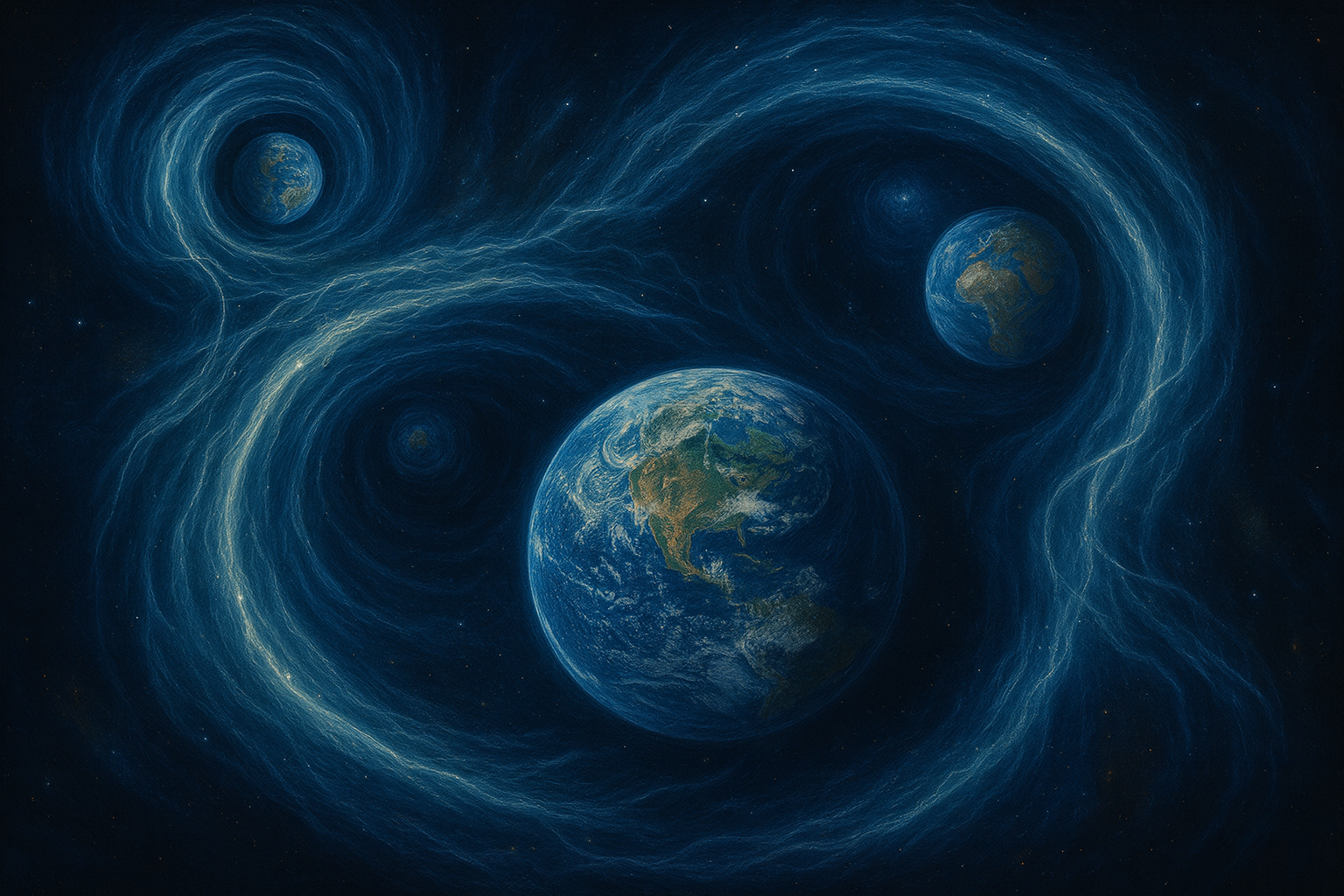
French astrophysicist Jean-Pierre Luminet states in books like The Foam of Space-Time that time is not an absolute, continuous reality but a granular illusion—a “mirage” that emerges from quantum and relativistic laws.
It doesn’t flow like a steady river: at the Planck scale (10⁻⁴³ seconds), it is discrete, like clock ticks, and relative depending on speed or gravity.
To illustrate this, let’s look at two landmark experiments that show time is local, observer-dependent, and not universal.
The atomic-clock experiment: time slows down in flight.
Imagine four ultra-precise atomic clocks, perfectly synchronized on Earth. In 1971, physicists Joseph Hafele and Richard Keating put them on commercial planes for a frantic round-the-world trip: two flights east, two west, totaling 90 hours at 900 km/h. Back at the U.S. Naval Observatory in Washington—surprise!
The flying clocks showed a lag of 59 nanoseconds (eastbound) or a gain of 273 nanoseconds (westbound) compared with the one left on the ground.
Why?
Einstein’s special relativity says fast motion stretches time: the faster you go, the “slower” your clock appears from outside. General relativity adds the gravity effect: at altitude, gravity is weaker, so time runs a tiny bit faster.
These tiny gaps prove time isn’t fixed; it stretches or shrinks like rubber, depending on speed and position.
Today, GPS systems include these corrections to avoid drifting by kilometers!
Langevin’s twin paradox: a trip that makes you younger.
In 1911, French physicist Paul Langevin created this story to popularize Einstein.
Take two identical twins, Pierre and Paul. Pierre stays on Earth, tending his garden. Paul, the adventurer, boards a spaceship racing at 99 % of light speed to a star 4 light-years away.
Round trip: 8 years for Pierre.
But for Paul? Only 1 year!
When he returns, Paul has barely aged, while Pierre is an old man.
The “paradox”? From Paul’s viewpoint in flight, Pierre seems to slow down!
The solution: broken symmetry. Paul accelerates, decelerates, and turns around (equivalent to a gravitational effect), curving his path in space-time and making it shorter in proper time.
It’s not an illusion: fast-moving cosmic muons live longer than expected, confirming differential aging.
These experiments support Luminet’s claim: time doesn’t “exist” as a single cosmic clock. It’s a flexible dimension woven into space, dancing to the rhythm of matter and motion. No eternal flow—just a relative echo of our reality.
Fascinating, right?
This surprising idea has several direct consequences in a world made of a single universe:
If time doesn’t exist, then the present doesn’t exist either, says Marc Lachièze-Rey: everything is relative.
An event seen as “now” or almost-now by one person can, at the same moment (per the atomic-clock test), appear as past to another person in a different setting, or even as future to a third, more shifted observer. In the end, the idea of a shared “present” loses all meaning.
If time doesn’t exist, the future is already written and can be accessed.
Lachièze-Rey speaks of relative duration rather than time. Each person moves through a pre-set scenery rather than through time.
If time doesn’t exist and the universe is unique, the future is already mapped out and knowable in broad strokes, sharply reducing free will—or eliminating it entirely. If someone’s future is already accessible, they can only live it out, unable to escape, following their karma.
If time doesn’t exist and the universe is unique, each person’s life path is unique and independent of others.
In the end, this means every person is isolated, pursuing their own path alone. It’s as if they lived in a simulation—a video game where they are the only active player, and everyone else they meet is just an NPC (non-player character) decorating the scene, vanishing the moment the main player looks away.
Looking at these last effects, we intuitively sense that a universe described this way cannot account for the complexity of the issues at stake in the world we know today—especially spiritual ones.
Given the religions and beliefs that exist in various forms across most civilizations, it’s unlikely that spirituality and free will don’t exist, or that otherness, brotherhood, love, and mutual help are mere illusions.
To resolve this lack of free will and the absence of spiritual values tied to relativity theory, other researchers like Philippe Guillemant have proposed a postulate increasingly shared by mainstream science: the multiverse.